Agentic Coding: The Guide
From the model to daily practice – how a language model becomes an engineering workflow whose results you can explain to your team.
Most people in the agentic space don't like to talk about models and opinions, because they think everything changes every few weeks. I think that's bullshit. I want to give you clear, opinionated guidance – as of November 2026 – on:
- how to do agentic coding
- what model to use
- what harness to use
- what app to use
- how to build your verification layer so that it works
- how to set up your workflows without bullshit-bingo buzzwords
- how to bring it all into practice in your day-to-day work, no matter if you're in a big enterprise or a solo developer
History
My personal model usage started over the Christmas holidays of 2025, and my favorite model at the time was Opus 4.5.
It was the first model I could really write high-quality code with. Until then, everything any model had ever spat out code-wise was slop to me – nothing I would use in production.
I will come to the quality standards of my work in the verification chapter. For now, let's continue the history:
- The second model I used was Opus 4.6, released on February 5, 2026.
- The third model was Opus 4.7, released on April 16, 2026.
- You've guessed it: the fourth model was Opus 4.8, released on May 28, 2026.
- That spring I had a real alternative for writing code, too: GPT 5.5 in the Codex app, next to Opus 4.7 and 4.8.
- In June I got to use the next generation, which was even better than Opus: Fable 5, released on June 9, 2026.
- Then I switched to Fable 5.1, released on September 1, 2026.
With Opus 5.5, released on September 22, 2026, I finally had two models to choose from: Fable 5.1 and Opus 5.5.
Today my favorite models are Fable 5.2 (released on November 9, 2026), Opus 5.5 and – for everything that is not coding – Gemini 4 Neon (released on November 18, 2026), in that order. For reviewing, I admit, I really like GPT-6.2 Astra and GPT-6.2 Sol, but no longer for writing the code. For coding, Gemini 4 Neon is not as good as Opus, but I like to use it for all sorts of other things – like booking a flight to Japan.
Look at that list again: in less than a year my main model changed six times, and – apart from one spring with GPT on the side – every single time it was simply the next model from the same company. That is how little actually changes.
Model
I use five models, each for the job it does best.
- Planning and orchestrating: Fable 5.2 at medium effort. My favorite choice for all of these tasks – I use it every day.
- Implementing: Opus 5.5. The model that writes my code.
- Research and everything that is not coding: Gemini 4 Neon.
- Reviewing: all five. The two Anthropic models, plus GPT-6.2 Astra, GPT-6.2 Sol and Gemini 4 Neon.
Why this split? Planning, architecture and orchestration get the strongest model, because a wrong assumption in the plan costs more than any token. The implementer has to be strong, fast and precise in following instructions. And a review is worth most when it comes from a model that did not write the code – which is why five models read my diffs, but only one writes them.
When a new version of one of these models arrives, I swap it in. The roles stay the same.
One more for everyone who pays API prices instead of a subscription: Sonnet 5.5. In my own bench it reached 94% of the Opus score for a fifth of the cost.
Harness
The harness turns the model into an agent: Agent = Model + Harness.
A coding agent is a language model in a loop: the model proposes an action, the harness runs the tool and hands back the result, and the model decides the next step. The harness also decides which tools, permissions and context the model gets – so it matters almost as much as the model itself.
My three favorite harnesses:
- Claude Code. I generally recommend subscriptions for agentic coding, and Claude Code is the only harness I can use with the Claude subscription.
- Pi. Built by an Austrian, Mario Zechner, and now developed at Earendil, the company co-founded by another Austrian, Armin Ronacher. In my human bench the same model cost about 60% in Pi of what it cost in Claude Code.
- opencode. In the same bench it was the cheapest harness of all – about half the cost of Claude Code – and it lets me try out a ton of models through OpenRouter.
Both Pi and opencode are open source – which is what I prefer. The bench figures compare cost only, with one model; the quality of those runs was not reviewed.
And the other models? The GPT models run in Codex on the ChatGPT subscription, Gemini runs in Antigravity – and T3 Code drives all of them from one place.
Orchestrator app
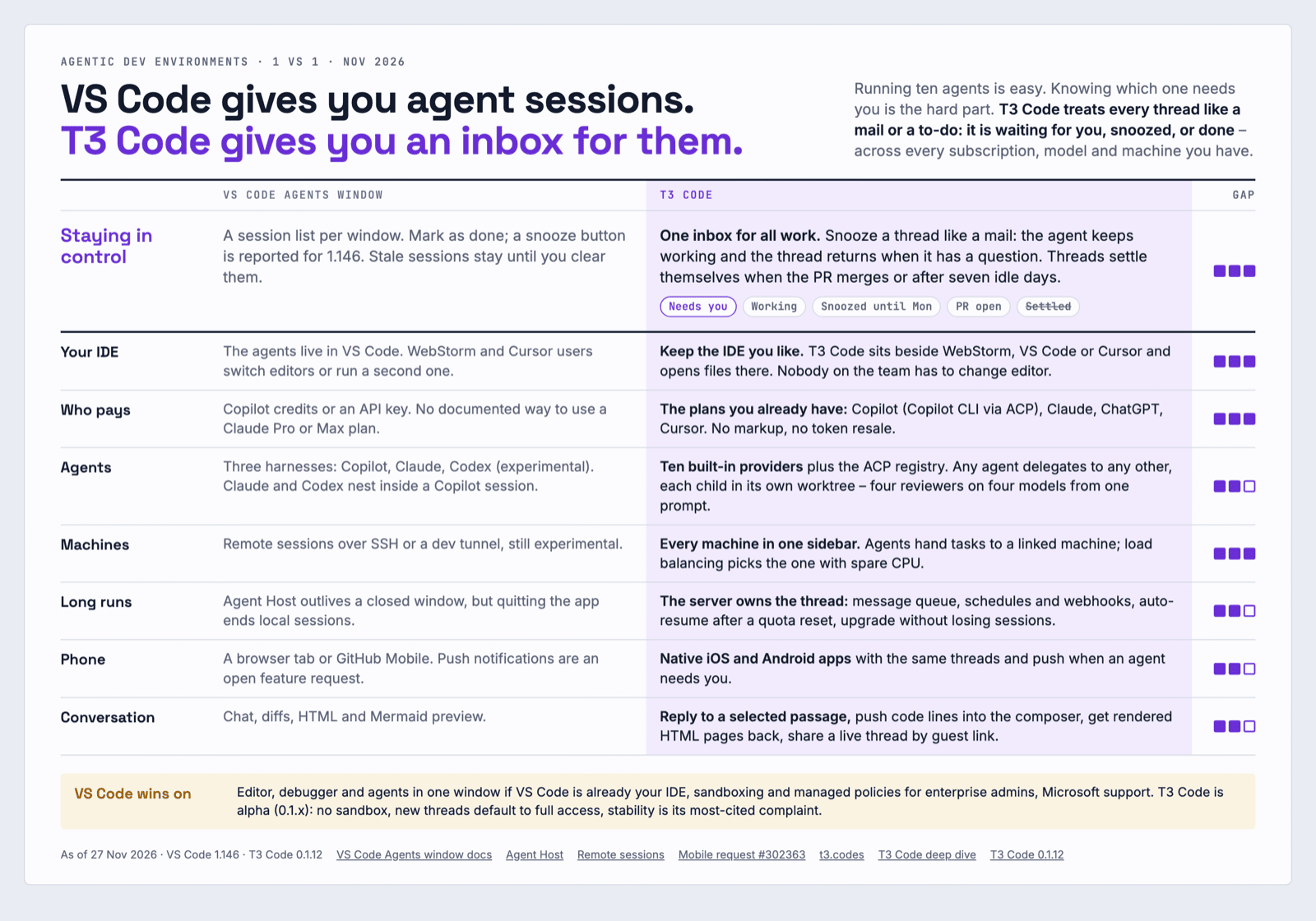
For the orchestrator app – also called the Agentic Development Environment – there is only one option in my opinion: T3 Code.
I'm a big T3 Code fan, and I think no other option comes close. Once an agent works reliably, the human becomes the bottleneck: running ten agents is easy, knowing which one needs you is the hard part. T3 Code treats every thread like a mail or a to-do – it is waiting for you, snoozed, or done – across every subscription, model and machine you have. And every thread works in its own Git worktree, so the agents do not get in each other's way.
Here is how it compares with the agent sessions of VS Code:
Verification layer
An agent is only as good as the signals it can check its work against.
Without verification the agent guesses whether its change works – and you find out in review. With verification it corrects itself before a human sees the diff. These are the seven layers I use. Each one stops what the layers before it cannot see, and each takes longer to answer:
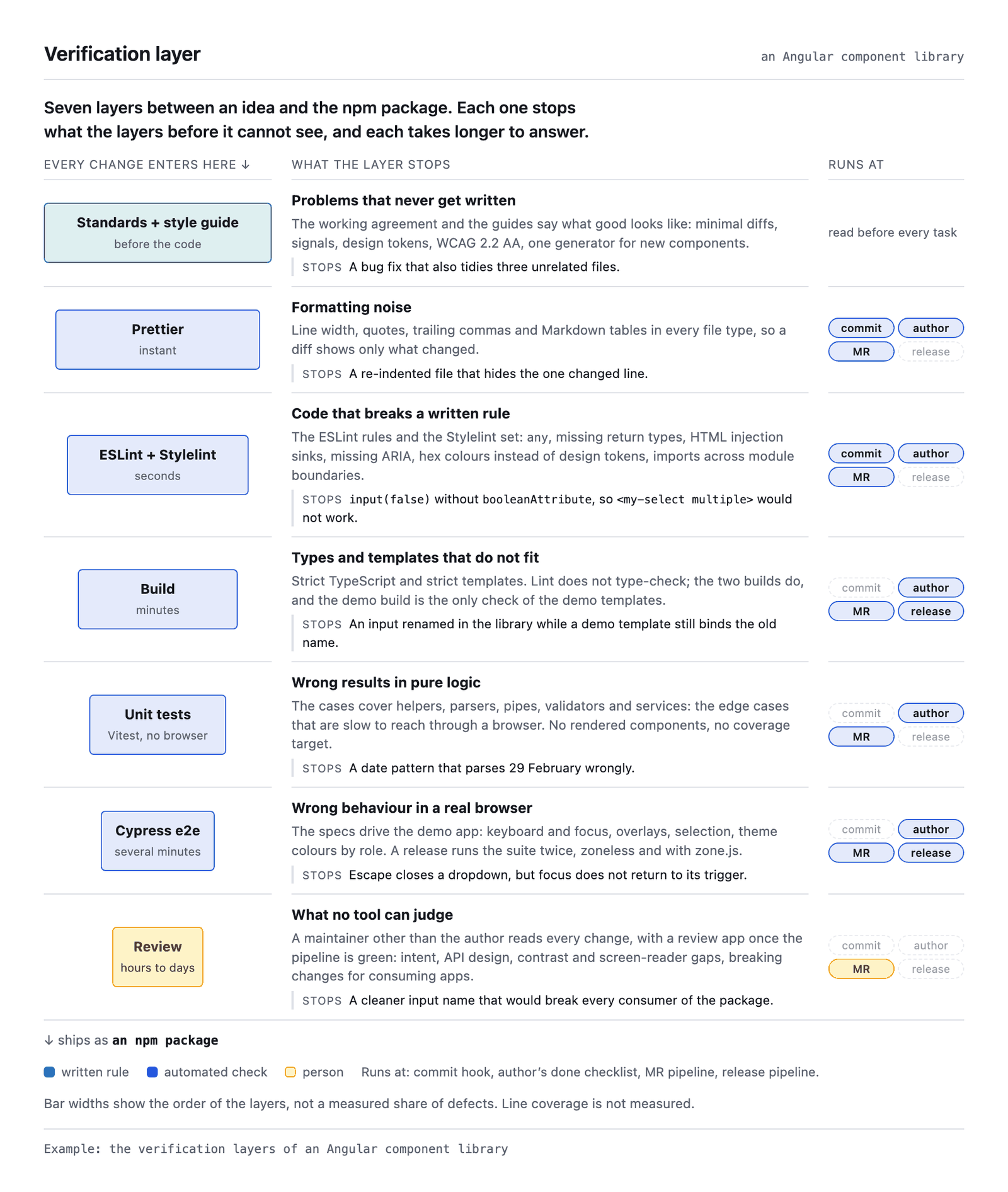
- Standards and style guide – before the code: the problems that never get written.
- Prettier – instant: formatting noise.
- ESLint and Stylelint – seconds: code that breaks a written rule.
- Build – minutes: types and templates that do not fit.
- Unit tests – wrong results in pure logic.
- E2E tests – wrong behavior in a real browser.
- Review – what no tool can judge.
Machines first: what a linter finds, no human should have to look for.
Agent instructions and workflows
Instructions are the contract between your team and every agent – versioned in the repository.
What is not written down, the agent does not know. What is written down at too much length, it does not read closely enough. This is everything I give my agents:
AGENTS.md: the lean entry point every tool reads – project context, what the agent may do without asking, and where the rest is. Tool-specific files point to it instead of copying it.- Coding standards: the working agreement on one page – tooling, Git, pull requests, implementation, and the checks a change has to pass before it counts as done.
- Style guide: one guide per file type – TypeScript, HTML templates, SCSS, accessibility, testing and more – loaded only when the agent touches such a file.
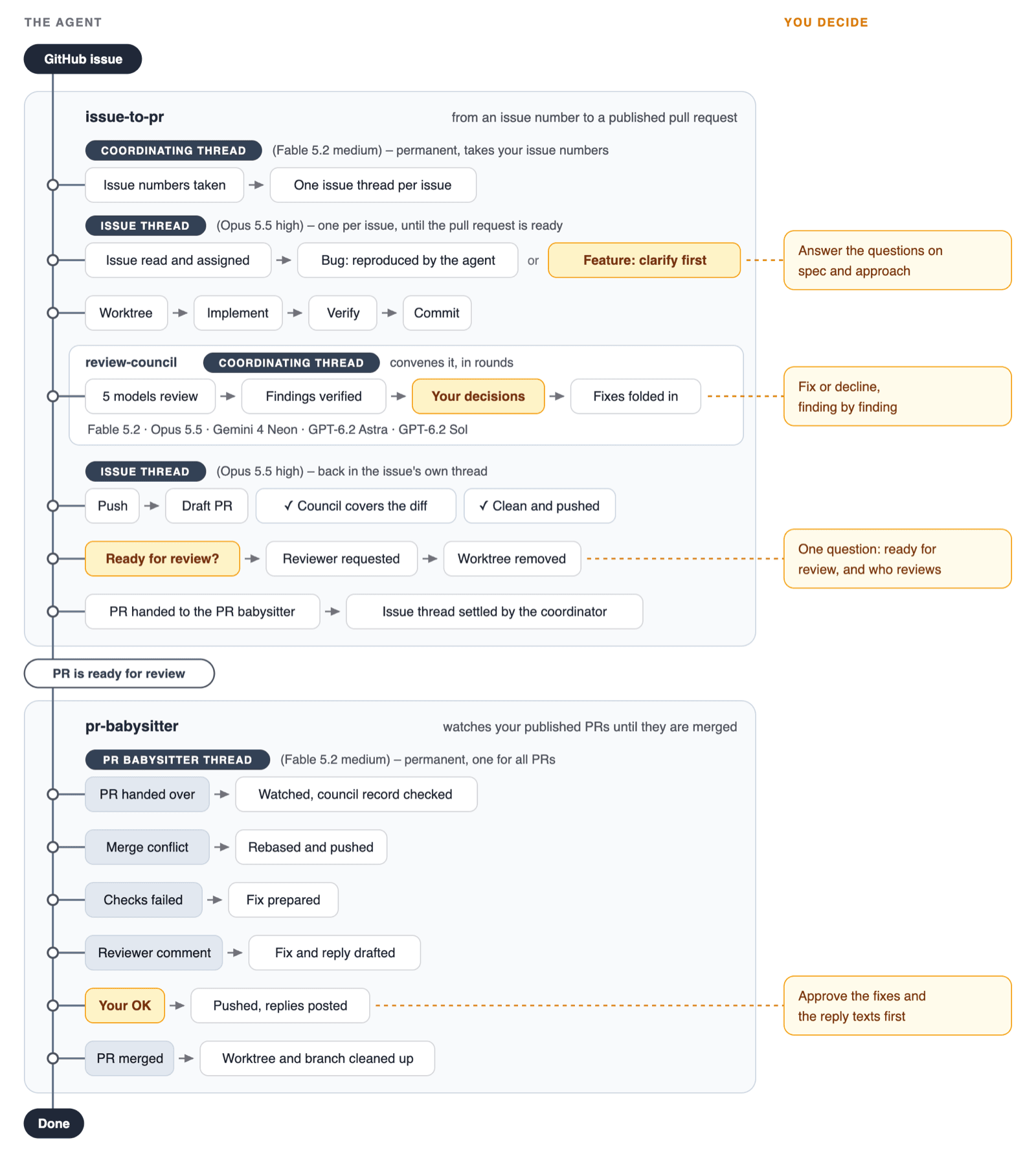
- Workflow skills: the procedures that take work from an issue to a merged pull request.
- Issue to PR takes an issue number to a published pull request: read the issue, reproduce the bug or clarify the feature, implement in its own worktree, verify, commit.
- Review council has several models review the same diff in parallel. The findings are verified against the code, and I decide finding by finding.
- PR babysitter watches the published pull requests until they are merged: it rebases on a conflict, prepares fixes for failed checks and drafts the replies to reviewer comments.
This is how the three workflow skills hand over to each other – and where I decide:
Maintain instructions like code: by pull request and with review.
In practice
In practice the size of the task decides how much process it needs.
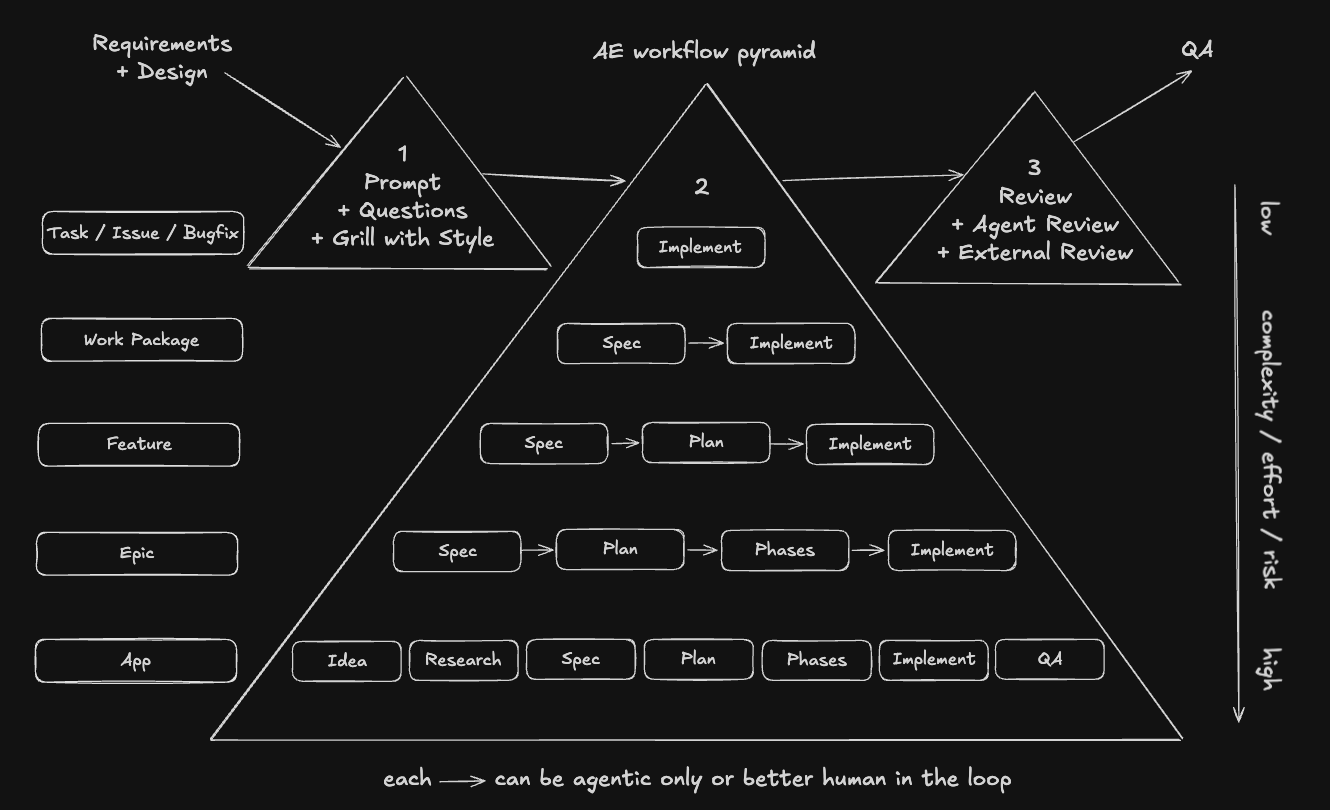
A bug fix needs a good prompt and a review. A feature needs a spec and a plan before the first line is written. Getting this dose right is the core of agentic engineering:
- The prompt: observation, goal, constraints, scope, and check. Paths instead of descriptions, screenshots instead of stories.
- The workflow pyramid: from bug fix through work package and feature to a new app. Spec, plan, and phases only where a wrong assumption would be expensive.
- Checkpoints: spec, plan, and diff pass your review before the agent carries on.
- The autonomy ladder: an agent runs unattended only when the goal is checkable, a feedback signal exists within the run, and guardrails limit the damage.
Want to build exactly this workflow with your team? In the two-day Agentic Engineering workshop we set it up together – on your own code.
Where to go from here: